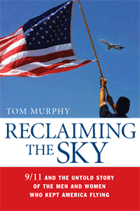
2026 Reclaiming the Sky
Resiliency Essay Competition Winners
(Scroll down for all three winning essays)
First Place
- Camille Ramsingh
Manager, Commercial Land Development and Leasing
Greater Toronto Airport Authority
Before reading Reclaiming the Sky, I believed resilience was something we discovered after adversity. I associated it with perseverance, determination, and the ability to recover from difficult circumstances. By the final chapter, however, I realized resilience begins much earlier. It is found in the choices we make while adversity is still unfolding and in the person those choices shape us to become.
What stayed with me most was not a single story, but a common thread woven throughout the book. The aviation professionals profiled in Reclaiming the Sky faced unimaginable uncertainty, yet they continued to show up for others. They comforted passengers, supported colleagues, and carried out responsibilities they never expected to face. They could not control what was happening around them, but they could control how they responded.
Reading their stories reminded me that resilience is often revealed through the choices people make when others need them most.
Ordinary people became extraordinary not because they sought recognition, but because they chose to serve.
One chapter in particular changed the way I think about both resilience and leadership. In Chapter 24, the author reflects on Janet Ott's presentation about Viktor Frankl's concept of the space between stimulus and response. While we cannot always control what happens to us, we always have the ability to choose our response. I realized that those small moments of choice shape more than the outcome of a difficult situation. They shape who we become. Every challenge gives us an opportunity to choose patience over frustration, collaboration over conflict, and purpose over fear. That lesson stayed with me because it applies just as much to everyday leadership as it does to moments of crisis.
As I reflected on that lesson, I found myself thinking about my own career. If someone had asked me years ago where my career would lead, aviation would not have been my answer. Today, I have the privilege of being part of an industry that keeps people, communities, and economies connected every day. Working in airport real estate, I spend much of my time balancing competing priorities, navigating different perspectives, and helping move projects forward. Early on, I thought leadership meant having the right answers. Experience has shown me that leadership is often much quieter than that. Sometimes it simply means remaining steady, listening carefully, and helping people move forward together even when the path ahead is uncertain. As Toronto Pearson undergoes significant revitalization and investment to support future growth, this lesson feels especially relevant. Periods of transformation inevitably bring change, uncertainty, and difficult decisions. In those moments, resilience is not demonstrated by avoiding challenges, but by helping teams navigate them with purpose, adaptability, and a focus on long-term success.
Reading these stories reminded me that behind every flight and every passenger journey are thousands of people whose commitment, often unseen, makes it all possible. It deepened my appreciation for the responsibility that comes with being part of this industry and strengthened my sense of purpose in the work I do.
What makes Reclaiming the Sky so meaningful is that it preserves the stories of people who never considered themselves heroes. The circumstances these aviation professionals faced were extraordinary, but the lessons they leave behind are timeless. Their stories remind us that resilience, compassion, and leadership are built one decision at a time, long before we ever know how those choices will matter.
As I continue my career in aviation, I hope that when I face challenges, I remember the lesson these stories taught me: resilience is not something we discover after adversity. It is something we choose in the middle of it. That is the legacy of Reclaiming the Sky I hope to carry forward.
• • •
Second Place
- Leon Sniegowski
Managing Consultant
Ricando and Associates
Reclaiming the Sky helped me understand resilience as more than simply enduring hardship. I have spent my entire professional career in the post-9/11 world, but reading the stories of people working in the aviation industry that day allowed me to revisit an event I remembered as a child and understand it more fully as an adult. In 2001, I was an eighth grader in Michigan.
My first memory of that morning was hearing between classes that the Pentagon had been bombed and then being led to my history teacher's classroom to watch the events unfold on a grainy television.
Over the next few hours, I slowly realized how much larger and more life-changing that day had become. Reading these stories brought me back to my middle school perspective while giving me an adult understanding of the weight others were carrying.
Looking back on 9/11 now, I realize that many of the people in the book were at a stage of life similar to mine today: building careers, raising young families, managing demanding jobs, and trying to maintain balance during a once-in-a-lifetime tragedy. As a child, I could not fully appreciate that level of responsibility.
Their experiences reveal resilience not as an abstract quality but as a practical responsibility lived out in the middle of everyday life.
What stood out to me most was that resilience begins with purpose. The aviation workers were connected to something larger than themselves: helping passengers, supporting coworkers, restoring airport operations, and rebuilding confidence in air travel. As an eighth grader, I sensed the fear of that day, but I could not understand what it meant to keep showing up for a family, workplace, and community while carrying that uncertainty.
As an adult, I recognize how difficult that responsibility can be. Their example reminds me to ask, "What matters most right now?" Purpose gives difficulty direction and provides a reason to keep moving forward.
Another lesson that stayed with me is the importance of remaining steady for others. Many stories in Reclaiming the Sky describe people offering comfort, leadership, and calm while struggling themselves. That resonates with me because I now understand that people can feel worried or exhausted while others still depend on them. With two kids at home and a team to lead at work, I have experienced how challenging it can be to remain steady when different parts of life demand attention at the same time.
Sue Baer's idea of "Slicing and Dicing" especially resonated with me: start somewhere, then move to the next piece, one step at a time. The book reminds me to listen carefully, communicate clearly, and take one constructive step forward. Even when I cannot solve everything, I can still be dependable.
The stories also reminded me that resilience is built over time. The work of "reclaiming the sky" did not end in a single day. People had to return, rebuild, grieve, adapt, and continue serving in a changed world. That perspective is meaningful because I sometimes expect myself to recover from setbacks too quickly. These stories remind me that growth requires patience. I can strengthen my own resilience by reflecting honestly, asking for support, learning from mistakes, and continuing forward even when progress is gradual.
Finally, Reclaiming the Sky reminded me that resilience also includes remembrance. The stories give me perspective when my own challenges feel heavy. They show that people can face fear and uncertainty while still acting with courage, kindness, and responsibility.
Remembering their experiences helps me remain humble and grateful, while encouraging me to treat others with compassion because I never fully know what burdens they may be carrying.
To me, the central message of Reclaiming the Sky is that resilience is active. It is demonstrated through daily choices: showing up, helping others, accepting reality, and choosing hope when circumstances are painful or uncertain.
The book allowed me to revisit a defining historical moment from two perspectives at once: the eighth grader I was then and the adult I am now. That contrast makes these stories especially powerful. They leave me with a model for how I want to face adversity—with purpose instead of panic, steadiness instead of withdrawal, and perseverance instead of defeat.
• • •
Third Place
- Brianna Covarrubias
Airport Compliance Coordinator
Port San Antonio
When people speak about September 11th, 2001, they can tell you exactly where they were, they can tell you how they found out, and more importantly they can tell you exactly how they felt. I, like Sue Baer's son Nicky, was in kindergarten that tragic day.
News of the attacks quickly spread over the country and even reached a 5-year-old midwestern kindergartener who was shocked and saddened at what had occurred. A young girl who never imagined she would learn so much about life from those directly affected by the tragic events of that day. Although I did not experience 9/11 firsthand, its impact shaped the career I chose, the people who mentored me, and the way I understand resilience.
Throughout my entire childhood and early teen years when asked "what do you want to be when you grow up?" my immediate response was that I wanted to become a teacher. It wasn't until my freshman year of high school when my AVID class welcomed an American Airlines Captain as our guest speaker, that I began to see aviation as a career path for myself. As a child, the American dream — and dreams of travel and adventure — had always been at the back of my mind but they suddenly seemed much more achievable that day. With the help of my teachers, I was able to attend an aviation career day at Southern Illinois University in collaboration with American Airlines. My fate was sealed. I worked hard the remainder of high school to be able to attend Vaughn College of Aeronautics and Technology with minimal financial obstacles.
While at Vaughn College, I studied Airport and Airline Management and had the absolute privilege of being one of Al Graser's students. Al Graser was the General Manager of JFK the day of the attacks. Though I learned so much about Airport Planning and Design from him, I also learned how much attention to detail truly matters. This is a trait I attribute to both him and Sue Baer. Because of their attention to even the smallest detail, they made and continue to make significant impacts on the lives of so many. Sue chose to rebuild, to show her team what it was to have compassion in the wake of such horrible circumstances. It is because of Sue, and people like her that I can carry myself with confidence and strength in my career today.
I was then fortunate enough to land an internship at The Port Authority of New York and New Jersey (PANYNJ) at LaGuardia during their reimagining of Terminal B. Here, I was blessed to meet so many who shared their wisdom on how to be resilient after having experienced such a life altering event. From managers who were in the towers that day, to the colleagues who became their lifelong family from that day forward. I am fortunate to be the person I am today because of their willingness to soldier on, to instill in the next generation what it means to overcome a tragedy like 9/11 and not let it stop you from fighting the good fight. This is not only true for those I met while at the PANYNJ, but also all the brave aviation employees mentioned in “Reclaiming the Sky.”
As I advanced in my career, I became a supervisor at JetBlue — an airline that originated in New York City just over a year prior to the attacks of 9/11. Here, I was able to experience firsthand the “space between” mentioned in “Reclaiming the Sky.” You may not always have a choice in the cards you’re dealt, but you can choose how to proceed once you see what you’ve been given. Working at an airport means that you never really know what the day may hold, every passenger and every employee you interact with is a chance to display how you have chosen to use the space between. Just like Anne MacFarlane always chose to make connections, to stay committed and to say yes, I chose to do the same while at JetBlue. I used my chance to ensure that my team felt sure of themselves and that they always had someone to reach out to when they needed support. Because of Anne, I know that resilience is not simply something we inherit but something we can pass on to others as well.
Reading “Reclaiming the Sky” by Tom Murphy has served as a bright reminder of how resilient we are as Americans, as aviation professionals, and as human beings. I now bring all these lessons to my current role as a Compliance Coordinator at Port San Antonio, as a stepmother of 3, as a soon to be wife. Whether it’s Al Graser’s attention to detail, Sue Baer’s perseverance, Anne MacFarlane’s connection, or the unrelenting bravery of those I worked alongside at the PANYNJ, I carry these lessons close to my heart.
On the 25th anniversary of 9/11 I pray that we never forget, and that we always remember those who chose to demonstrate to that 5-year-old girl, and so many like her, what it truly means to be resilient.
• • •
Program offered by the Human Resiliency Institute at Fordham, in partnership with Airports Council Int’l-NA, and sponsored by SSP America.
← Return to Home

|

Tom Murphy
Director, Human Resiliency Institute at Fordham University, and President, Service Institute
Contact Tom at: Tom@TomMurphy.org
|
|